
- 05/09/2026
- by Uddhav Hargude
- Blog
If your gynaecologist has just handed you a prescription for a double marker test, you’ve probably already typed “double marker test normal values” into Google at least once. That’s a completely fair reaction. The report comes back full of ratios and numbers that mean nothing to most first-time parents, right when you’re already anxious about how the pregnancy is going. This guide breaks down what the test actually checks, what a normal result looks like, and what a high-risk result really means (spoiler: it’s not a diagnosis).
What Is a Double Marker Test?
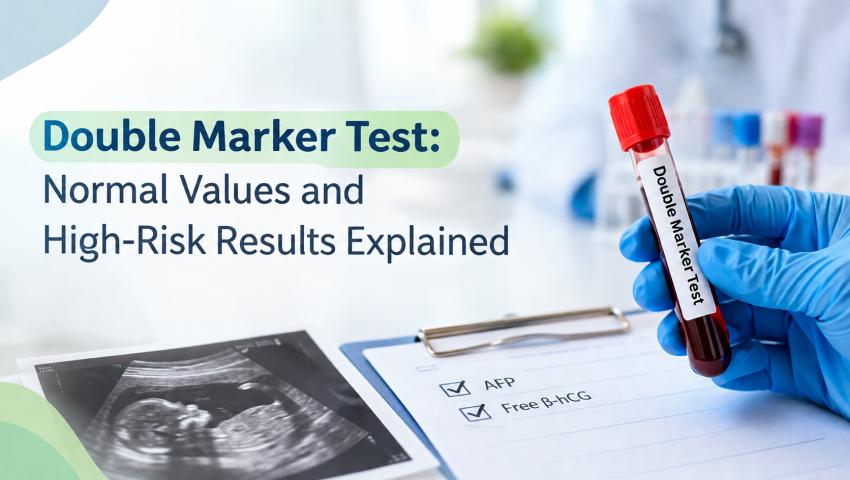
The double marker test is a first-trimester blood test that measures two substances in the mother’s blood: free beta-hCG and PAPP-A (pregnancy-associated plasma protein-A). Both are produced by the placenta, and unusual levels of either one can be an early signal for chromosomal conditions like Down syndrome (Trisomy 21), Edwards syndrome (Trisomy 18), or Patau syndrome (Trisomy 13).
On its own, the blood test gives a partial picture. It’s most accurate when combined with an NT scan, an ultrasound that measures the fluid space at the back of the baby’s neck. Together, these two results plus your age and weight are run through an algorithm that produces your final risk score.
Double Marker Test Normal Values:
Here’s the part that trips most people up: there isn’t one single “normal number” for hCG or PAPP-A that applies to everyone. Labs report these markers as MoM, or multiples of the median, which adjusts for your exact week of pregnancy and lab equipment. A MoM close to 1.0 for both markers generally points toward a low-risk pregnancy, but this isn’t something you should try to eyeball yourself.
What matters more than the raw numbers is the final risk ratio, printed near the bottom of your report as something like 1:250 or 1:1400. Read it as “1 chance in 250” or “1 chance in 1400.” Broadly:
- Low risk (screen negative): ratio around 1:1000 or better
- Moderate to high risk (screen positive): ratio between roughly 1:10 and 1:250
The exact cutoff differs by lab, so the specific threshold used to flag your report as normal or high-risk will be printed on the document itself. If you’re unsure which category your number falls into, your prescribing doctor is the right person to confirm it, not a Google search. For more on what these draws involve, our guide on how many blood tests you’ll actually need during pregnancy covers the full picture beyond just this one test.
What Does a High-Risk Result Mean?
Seeing “screen positive” or “high risk” on a report is frightening, so let’s be direct about what it does and doesn’t mean.
It does not mean your baby has a chromosomal condition. The double marker test is a screening test, not a diagnostic one. A high-risk result means the statistical probability crossed your lab’s cutoff, which triggers a recommendation for further testing—nothing more. Many high-risk results turn out completely normal once confirmed.
It does mean your doctor will likely suggest one of two paths: an NIPT test (a more sensitive blood-based screen using fetal DNA) or a diagnostic procedure like CVS or amniocentesis, which can confirm a chromosomal condition directly. NIPT is non-invasive and usually the first recommendation; CVS and amniocentesis carry a small procedural risk but give a definitive answer.
Dr. Sagar Sujanyal, the radiologist at Pearl Diagnostics who performs the accompanying NT scan, notes that an isolated high-risk score without a matching NT finding often prompts doctors to recheck dating and repeat the ultrasound before moving to further testing, since an inaccurate gestational age is one of the most common reasons for a skewed result.
Next Steps After a High-Risk Report:
If your result comes back high-risk, here’s roughly what happens next:
- Your gynecologist reviews the full report, not just the risk ratio, alongside your NT scan and medical history.
- You’ll likely be offered NIPT first, since it’s non-invasive and significantly narrows down the risk before considering an invasive test.
- If NIPT also comes back high-risk, or your doctor recommends skipping straight to a diagnostic test, CVS (around 11 to 13 weeks) or amniocentesis (after 15 weeks) can confirm the finding directly.
- Genetic counseling is often offered at this stage, and it’s worth taking up. It helps you understand what the specific numbers mean for your situation rather than researching alone at 2 a.m.
Try to hold off on catastrophizing until you’ve had this conversation. A high-risk flag is designed to prompt more information, not to deliver a verdict.
What Can Affect Your Result?
A few factors outside the pregnancy itself can shift your numbers, even in a completely healthy pregnancy:
- Maternal age: baseline risk naturally rises with age, and the algorithm accounts for this
- Weight: Higher maternal weight can dilute hormone concentration in the blood sample.
- Gestational dating errors: If the pregnancy is dated incorrectly, the marker levels get compared against the wrong week.
- Twin pregnancies: marker levels run higher with multiples, which need separate interpretation
- IVF conception: hormone levels can differ slightly from spontaneous conception.
None of these guarantee an abnormal result, but they’re part of why your doctor looks at the full context instead of a single number.
Double Marker Test Cost in India:
Pricing varies by city and lab, generally landing somewhere between roughly ₹1,200 and ₹2,500 for the blood test alone, with the combined NT scan adding to the total. (This is a general market range and not a quoted Pearl Diagnostics price. Please call to confirm current pricing.) For a look at how this fits alongside other pregnancy blood tests you’ll need across the nine months, our team can walk you through the full schedule during your first visit.
If you’re still figuring out exactly which week to book this test, our week-by-week guide to booking your double marker and triple marker tests breaks down the timing in more detail.
To book your double marker test or NT scan at Pearl Diagnostics, Shastri Nagar, Pimpri, call +91-9156959267.
Key Takeaways:
A double marker test doesn’t give you a yes-or-no answer, it gives you a probability, so try not to read too much into a single number without context.
- Normal (low-risk): ratio around 1:1000 or better on most reports
- High-risk: ratio roughly between 1:10 and 1:250, which simply means more testing is worth doing, not that something is wrong
- Timing matters: get it done between 11 and 13 weeks 6 days, alongside the NT scan, for the most accurate reading
- A high-risk flag is a prompt, not a verdict. NIPT, CVS, or amniocentesis can give you clarity
FAQs:
A normal, or “low-risk,” result usually means your risk ratio is around 1:1000 or higher, meaning the calculated chance of a chromosomal condition is very low. The exact cutoff is set by your lab and printed on your report. Your doctor will confirm what your specific number means.
A high-risk result means your risk ratio fell below your lab’s cutoff, commonly somewhere between 1:10 and 1:250. It is not a diagnosis. It simply signals that further testing, such as NIPT or amniocentesis, is recommended to get a clearer answer.
No, it is not legally mandatory, but it is strongly recommended by most gynecologists as part of routine first-trimester screening. It helps flag pregnancies that may benefit from closer monitoring or additional testing, especially for mothers over 35.
Yes, and it often does. A high-risk screening result is not a diagnosis. Many babies flagged as high-risk are confirmed completely healthy after follow-up testing like NIPT or amniocentesis. The test estimates probability, not certainty.
The double marker test estimates risk using two blood markers plus an NT scan. NIPT analyzes fetal DNA in the mother’s blood and is more accurate, though still a screening test. Doctors often recommend NIPT as a next step after a high-risk double marker result.
It’s typically done between 9 and 14 weeks of pregnancy, ideally between 11 weeks and 13 weeks 6 days, alongside the NT scan. Testing outside this window reduces accuracy, so timing it correctly with your doctor matters.